
Recent research from Gartner reports that 64% of customers would prefer companies that don't use AI for customer service. And, according to Agility PR, after just one frustrating experience with AI-supported customer service, 70% of polled consumers indicated they would consider a different brand for their next purchase.
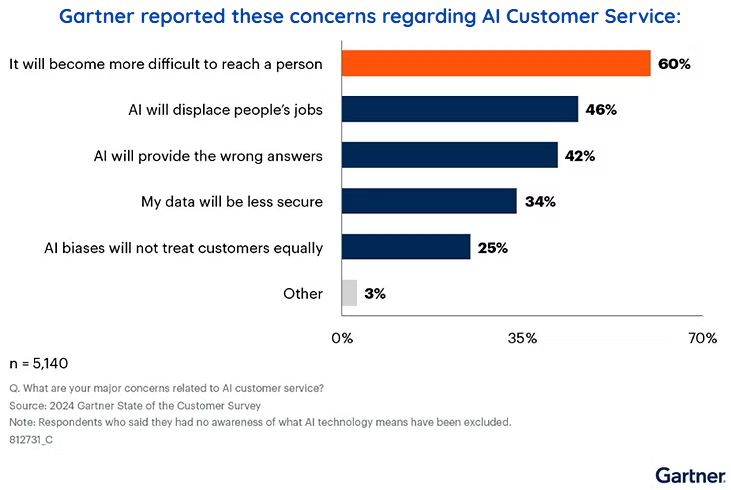
On the surface, adopting AI-powered customer service to reduce costs and increase efficiency seems wise. However, this is not the case when it eliminates or hamstrings interactions that drive user adoption and loyalty and inform a longer, healthier product lifecycle.
AI can improve or facilitate many of those interactions, and good products often convince people of needs they don't know they have. However, good businesses also don't ignore what their customers say they find valuable, and enterprise software users still value human-led customer support.
AI-led support often prioritizes speedy resolution and reduces nuanced technical challenges to simpler-to-solve problems—prioritizing suggestions for what is the most likely issue, not necessarily resolving the exact issue. That's frustrating enough as a time-sink. But often, when enterprise software users seek support, they are not facing a technical problem but a "solutioning" challenge. They need an opportunity to solve problems through shared analysis and planning and then apply them to the software.

People are 2.5 times more positive about their experience chatting with humans than AI chatbots. This is because stressful and time-sensitive situations require compassion, understanding, and patience to be resolved effectively and satisfactorily.
Our clients are facing complex, high-stakes legal matters, so they must use tailored workflows to lead them to success. Relying on AI to help them would mean ignoring the need to uncover or design solutions through conversation.
It also gives us a chance to validate and dispel the unavoidable frustrations of hard work – that they could be doing everything right and just needed a refresh on a feature they haven't used since their last giant case. The reassurance we can offer to a people problem as people is as important as the technical fixes we provide.
"Reviewer First" customer support helps eDiscovery professionals create the best repeatable experiences for high-stakes matters and standards. Support must be as quick, accurate, and versatile as they are with their end clients.
Since 2018, the total volume of data worldwide has grown from 33 zettabytes to a staggering 149 zettabytes. The ratio of total relevant materials remained the same in that period, hovering between 1% and 5%.
It's also not an exaggeration to say expectations for eDiscovery specialists have grown exponentially alongside document universes. This data growth demands teams learn and work with tools quickly and effectively.
A "Reviewer First" approach ensures those expectations remain manageable by having human beings available for urgent needs and proactively helping teams create reusable work product to reduce the hours spent using the tools.
It might seem counterintuitive to encourage eDiscovery professionals to spend less time with your tools – but it's not if it's showing them how to get better results faster so they can return their focus to the "bigger fish" they have to fry.

Variety isn't nice to have; it's necessary to offer when people are expected to learn and regularly use software as complex as Relativity. The work performed in Relativity and systems like it is too essential and too specific for one-size-fits-all solutions or learning models.
Teams providing "superior support" for enterprise software environments need to adopt a similar philosophy. Accounting for different learning styles results in better comprehension and retention of how to engage the software effectively. That, in turn, results in a higher ROI for the customer purchasing the software.
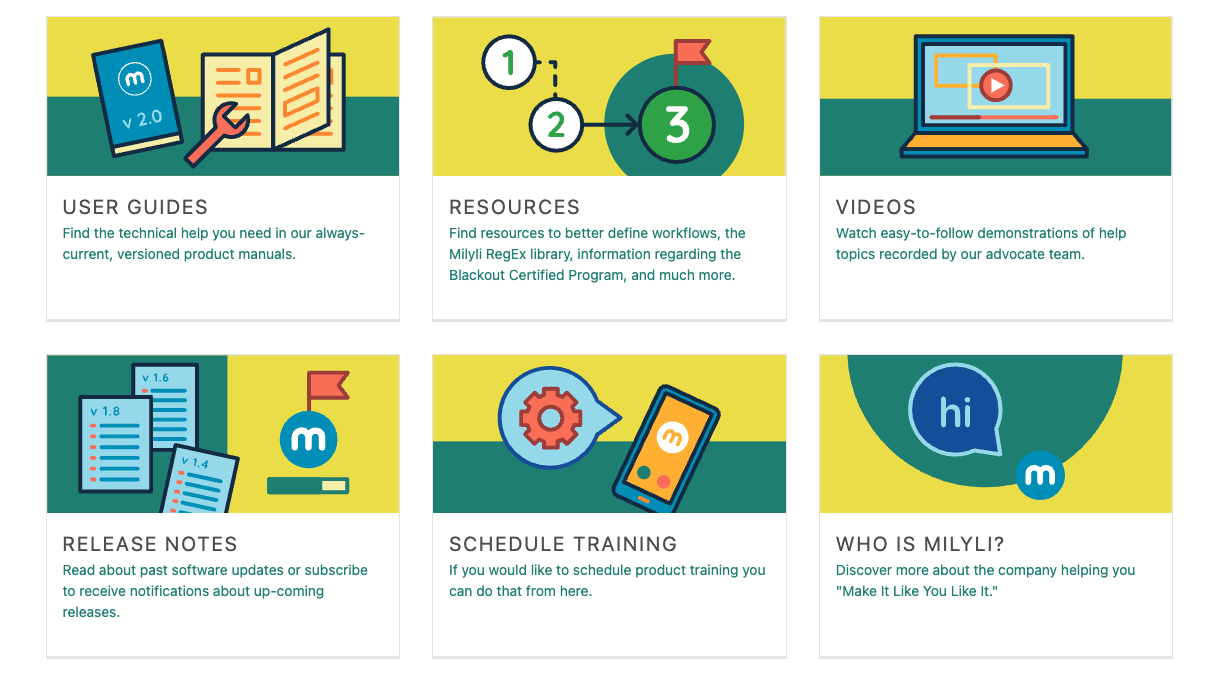
Great service should be an expectation for anyone purchasing software that manages serious matters and important personal information.
At Milyli, customer support takes on responsibilities beyond pointing people to a help article or relaying bugs to our engineers.
Whether you are ticketing with Cooper for help with a series of irregular Regular Expressions or meeting with Jeffrey to outline a hosted training for your newest team members, you'll be given care and consideration a bot won't ever match, much less surpass in value.
